
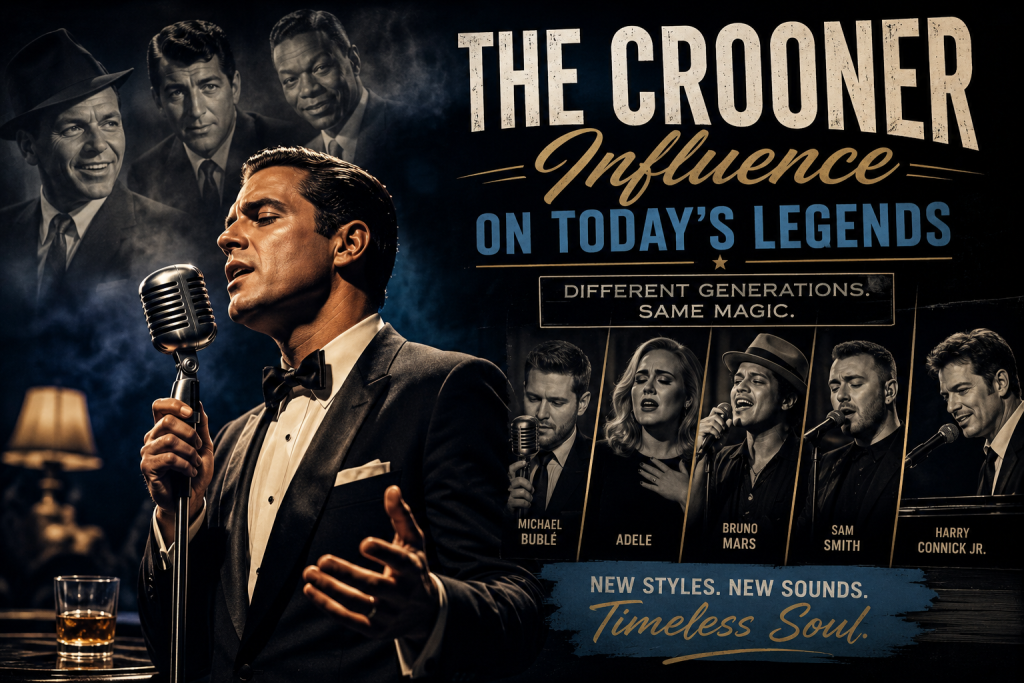
Modern music likes to pretend it reinvents itself every six months, a new trend, a new genre, a new buzzword. Or, a new twenty-three-year-old music “expert” explaining why guitars are dead for the seventeenth time, or that ROCK is dead, blah.
Meanwhile, somewhere in the background, a guy in a tailored jacket steps up to a microphone and reminds everybody that emotion still matters more than production tricks. That’s the thing about crooners. They never actually disappeared.
The word “crooner” usually makes people think of smoky lounges, old Vegas stages, Frank Sinatra holding a drink like he knew something the rest of the room didn’t, or Dean Martin sounding cooler than every human being who has existed since. But crooning was never really about tuxedos. It was about intimacy. Crooners sang like they were talking directly to you instead of performing at you. That changed music forever, some say for the better.
Before microphones became sophisticated, singers had to project loudly enough to reach the back row of giant theaters. Subtlety didn’t work. Then technology evolved and suddenly singers could whisper, soften their phrasing, pause for emotion, and let vulnerability creep into performances. The crooners mastered that first. Remember all of those choir practice sessions with the director saying “sing from your diaphram”?
Today’s biggest artists are still using the blueprint whether they realize it or not. Listen closely to modern vocal performances and you can hear traces of Sinatra, Nat King Cole, Tony Bennett, Bobby Darin, and Bing Crosby everywhere. Not necessarily in the genre itself, but in the delivery – the phrasing, the restraint, the conversational timing, the confidence to let a lyric breathe.
Michael Bublé built an entire career carrying the crooner tradition into modern pop culture. Harry Connick Jr. blended jazz, pop, and classic vocal styling into something contemporary audiences could still connect with. Even artists outside traditional pop channels borrowed heavily from the approach. That influence stretches farther than people think.
Adele’s emotional control often feels closer to classic vocal storytelling than modern oversinging competitions. Bruno Mars understands smooth phrasing and vocal charisma in ways that feel deeply connected to older performance traditions. Lady Gaga shocked people during her jazz collaborations not because she suddenly learned how to sing, but because audiences realized how much classic influence had always been hiding underneath the pop spectacle. Even rock artists absorbed it.
Listen to the quieter moments from singers like Chris Cornell, Eddie Vedder, David Bowie, or Bryan Ferry. Beneath the power and attitude sits an understanding of tension, pacing, and emotional control that owes a lot to old school vocalists who understood that pulling back can sometimes hit harder than screaming.That’s one reason the best singers age well.
Trends change, production changes, fashion changes, but emotional communication never goes out of style. The crooners understood something the algorithm era occasionally forgets: people do not fall in love with perfection. They fall in love with humanity. Some would say they are even responsible for CREATING news humans, wink, wink.
Modern production often edits vocals until they sound mechanically flawless. Every note aligned. Every breath cleaned up. Every imperfection sanded away like somebody restoring an old kitchen table. And yet audiences still obsess over live performances where a singer cracks emotionally or drifts slightly off pitch because those moments feel real. Crooners built careers on that feeling. They weren’t trying to overpower songs. They were trying to inhabit them.
That influence quietly shaped entire generations of performers. You can hear it in acoustic music, soul, indie rock, jazz influenced pop, Americana, and even certain alternative artists who lean into vulnerability instead of sheer technical power.
Ironically, some of today’s most emotionally effective singers are basically modern crooners wearing different clothes. The staging changed. The genres changed. The tattoos increased dramatically. But the core idea survived.
Stand near the microphone. Mean what you’re singing. Make people feel like the song belongs to them. That formula worked in 1955. It still works now.
And honestly, it probably still will long after whatever dance trend currently dominates social media gets mercifully launched into the sun
– R Masters