
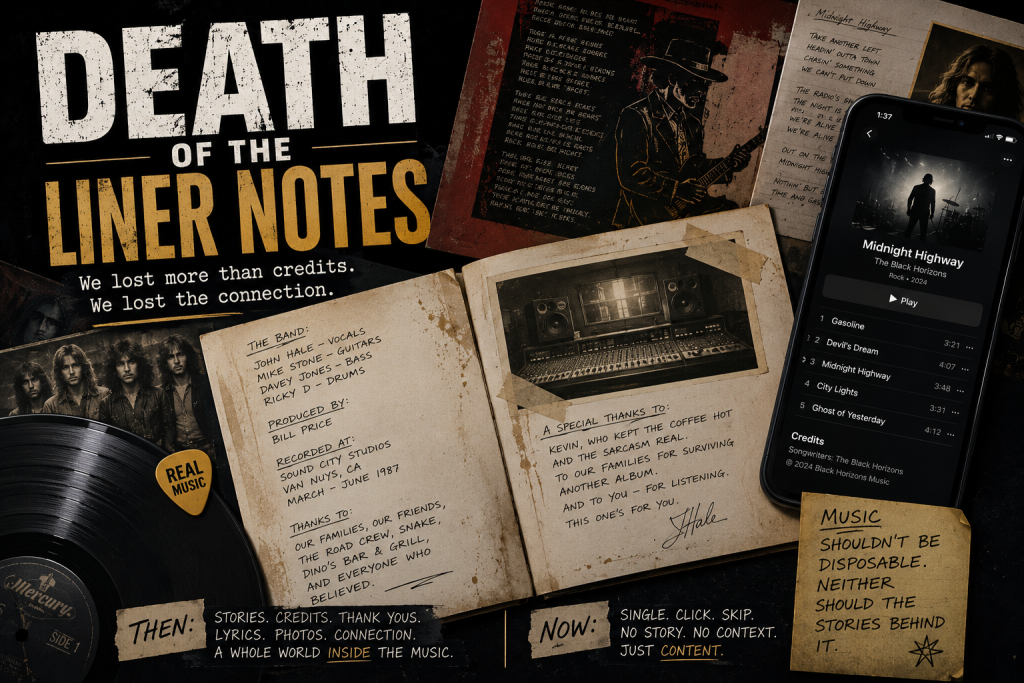
There was a time when buying an album felt like entering a secret society. You didn’t just listen to the music. You held it. You studied it.
You unfolded the liner notes like you were decoding ancient scrolls discovered in the back room of a record store that smelled faintly of cardboard, incense, and questionable life decisions.
Kids today stream a song in four seconds while simultaneously watching somebody make tacos on social media and arguing about Batman rankings with strangers.
Meanwhile, an entire generation used to sit cross legged on the floor staring at album artwork while listening to Side A in complete silence like tiny emotionally confused music monks. We bought the albums, placed our ears between our speakers, and read along to; lyrics, who is singing backup, and where certain parts were recorded. And honestly? We lost something important when liner notes disappeared.
Liner notes were never just credits.They were part of the experience. We didn’t know anything about the artist unless we got five minutes in the magazine section of the supermarket reading Rolling Stone because we couldn’t afford a subscription.
That was where you discovered who played the impossible guitar solo. Where you learned that three different people somehow played “additional percussion.” Where you found out your favorite singer thanked a girlfriend, two dogs, a road manager named Snake, and “everyone at Dino’s Bar and Grill.”
Liner notes made music feel human. They revealed the chaos behind the curtain.
Sometimes they were heartfelt. Sometimes hilarious. Sometimes completely unhinged. Occasionally they looked like they were designed at 3:12 a.m. by somebody who had not slept since the Reagan administration. And they were glorious.
The artwork mattered too. Album packaging used to be immersive. Gatefold sleeves. Hidden photos. Lyrics printed over impossible backgrounds nobody could actually read. Entire visual worlds built around forty five minutes of music.
You learned bands through those details. You discovered producers. Who were the Engineers, Session Musicians, Studios, Influences. No, NOT INFLUENCERS!
Music fans accidentally educated themselves because they were curious enough to keep reading. Dick Clark told us that a song “had a good beat and was good to dance to.” The interview with the band told us NOTHING! In fact, we were actually surprised when we learned that certain bands weren’t one person named Lynyrd.
Now? Most streaming services barely tell you who wrote the song. Sometimes you’re lucky if the album cover isn’t reduced to something the size of a postage stamp floating between advertisements and podcast recommendations nobody asked for.
The weird thing is that people still crave the experience liner notes created. That’s why vinyl exploded again.
It isn’t just audio quality. Most people arguing online about “warmer analog sound” are listening through Bluetooth speakers the size of a grilled cheese sandwich anyway. What they miss is connection. Physical music demanded attention.
You listened to albums front to back because skipping tracks required actual effort. You memorized artwork because you stared at it while the record played. You knew band member names because they were physically printed in front of you instead of buried inside a metadata tab nobody clicks.
Music felt intentional. Streaming made music convenient. Convenience made music disposable. That may be the harshest trade in modern entertainment.
Entire albums now appear and vanish from public attention in less time than it takes to finish a decent road trip playlist. Artists spend years creating projects that audiences consume while checking email at work and deciding whether they need paper towels from Target.
The ceremony disappeared. And ceremony matters more than people think.
Liner notes helped create emotional memory. Fans attached songs to images, typography, thank you notes, studio stories, and visual identity. Albums became time capsules instead of background noise. That experience shaped generations of music lovers.
Ironically, this may be one reason artist pages and music communities are becoming important again. People still want context. They want stories, credits, history, meaning, and connection.
They want to know who played on the track. What inspired the lyrics. Which producer nearly drove everybody insane. Why the drummer quit halfway through recording. Why that album cover looks like it was photographed inside an abandoned submarine. Fans do not just want content. They want mythology.
The old liner notes understood that perfectly. And maybe that’s the real opportunity now. Not recreating the past exactly. But rebuilding the feeling that music is something worth exploring instead of something endlessly skipped after eleven seconds because the algorithm got bored.
Or, maybe all of this is just bullshit and we have to wait on AI to take over everything.
(The opinions here do not represent those of Masters Radio or its management. Or, maybe they do. You wouldn’t know if it was true or not. So get over it)