
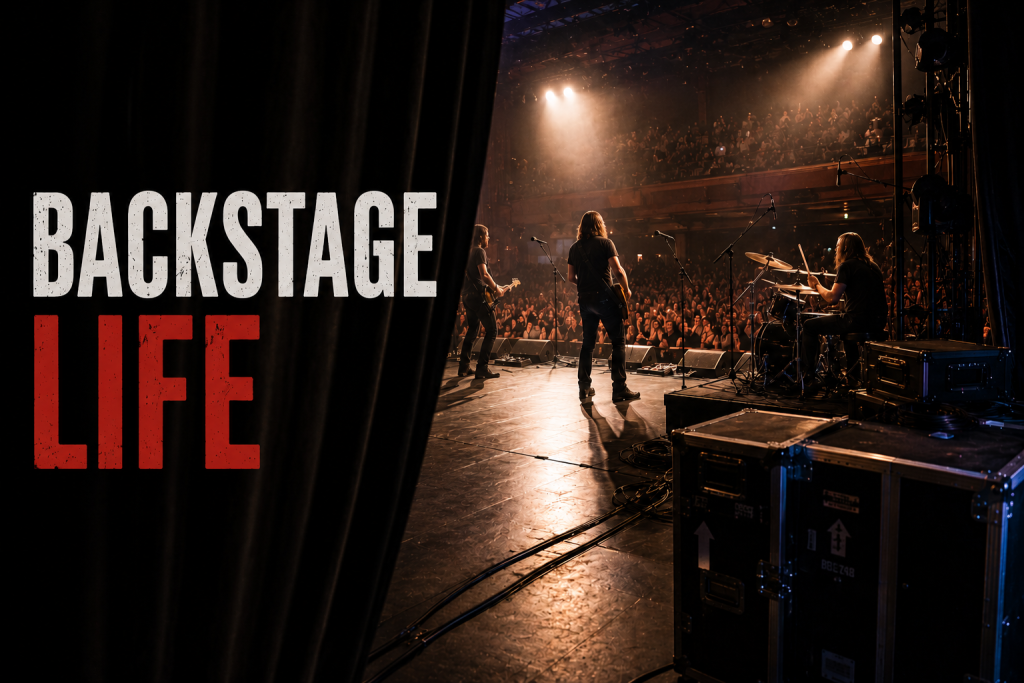
People romanticize backstage access because they imagine it as access to fame. Most artists experience it as access to work. Think about your own job for a second. Would you want strangers wandering into your office while you’re trying to prepare for a major presentation?
Would you want somebody hovering nearby while you:
- focus
- rehearse
- solve problems
- calm your nerves
- coordinate with coworkers
- prepare mentally to perform in front of thousands of people
Probably not. But musicians are expected to do exactly that all the time.
Fans often imagine backstage as a reward. For artists, it’s frequently the final preparation zone before work begins. Drugs, booze, and groupies may exist, but they are mostly a fantasy after a certain age.
That guitarist running scales in the hallway? That’s not “rock and roll behavior.”
That’s somebody preparing for their shift.
The singer is sitting quietly in the corner protecting their voice? That’s not arrogance. That’s concentration.
The band is discussing setlists? The crew is checking cables? Management reviewing timing? Production staff coordinating cues? That’s work. High-pressure work.
And honestly, most artists are remarkably gracious considering how often complete strangers expect emotional access to them while they’re trying to stay mentally locked in before walking onstage.
The strange thing about fame is that audiences feel emotionally connected to artists while forgetting the artist has never actually met them. Just because you have listened to their music for fifty years doesn’t mean they care about where you first heard their music.
Music creates intimacy. Reality creates boundaries. The healthiest artists learn how to balance both. And the best backstage experiences usually happen when fans understand that difference.
Ironically, respecting artists like professionals instead of attractions often creates more genuine interactions anyway. Because the moment stops becoming: “OMG THERE THEY ARE.” And starts becoming: “Hey, that’s another human being trying to do their job well.”
That perspective changes everything.
We have had the experience to know that if we don’t end up backstage, it sometimes can be a blessing for all involved. In our business, a quick phone call or email does more for an artist relationship than swapping stories at midnight in a hallway.