
There was a time when concert tickets felt expensive. Now they feel financially invasive.
People are not casually “going to shows” anymore. They are opening budgeting spreadsheets, checking credit card balances, skipping dinners out for two weeks, and quietly calculating whether seeing one artist is worth temporary emotional bankruptcy.
And look, artists deserve to make money. Crew members deserve to make money. Venues deserve to make money. But somewhere along the way the entire system drifted completely off the rails.
We are not buying a car. We want to see Beyoncé.
Fans now enter online ticket queues like contestants in a psychological endurance experiment. You log in early. You refresh constantly. You stare at countdown clocks while your anxiety rises like you are trying to secure emergency evacuation seating from an active volcano. Then the fees arrive. Oh yes. The fees.
A $140 ticket somehow mutates into:
- service fees
- processing fees
- convenience fees
- digital delivery fees
- venue fees
- “because we can” fees
At this point people expect Ticketmaster to eventually add: “emotional damage surcharge.”
What is hard to believe is that fans keep paying because live music still matters that much to people. That’s the real story underneath all of this.
Music is one of the few things left that still creates genuine emotional connection at scale. People will sacrifice for experiences that feel real. The industry knows that. The monopolies definitely know that.
Which brings us to the uncomfortable word nobody likes discussing: control.
When a small number of companies control:
- ticketing
- venues
- distribution
- resale ecosystems
- pricing structures
- and fan access
…you no longer have a healthy market. You have a kingdom. And kingdoms rarely lower prices out of kindness.
The secondary resale market made everything even uglier. Tickets now get treated like stock portfolios by people who have absolutely no interest in music whatsoever. Bots vacuum up inventory in seconds, then relist seats at prices that make fans briefly consider whether standing outside the venue listening through concrete walls is a reasonable life decision.
Meanwhile the average fan just wants:
- one night of escape
- one memory
- one shared experience
That used to be the soul of live music. And now the industry is running into something fascinating: the blue dot phenomenon.
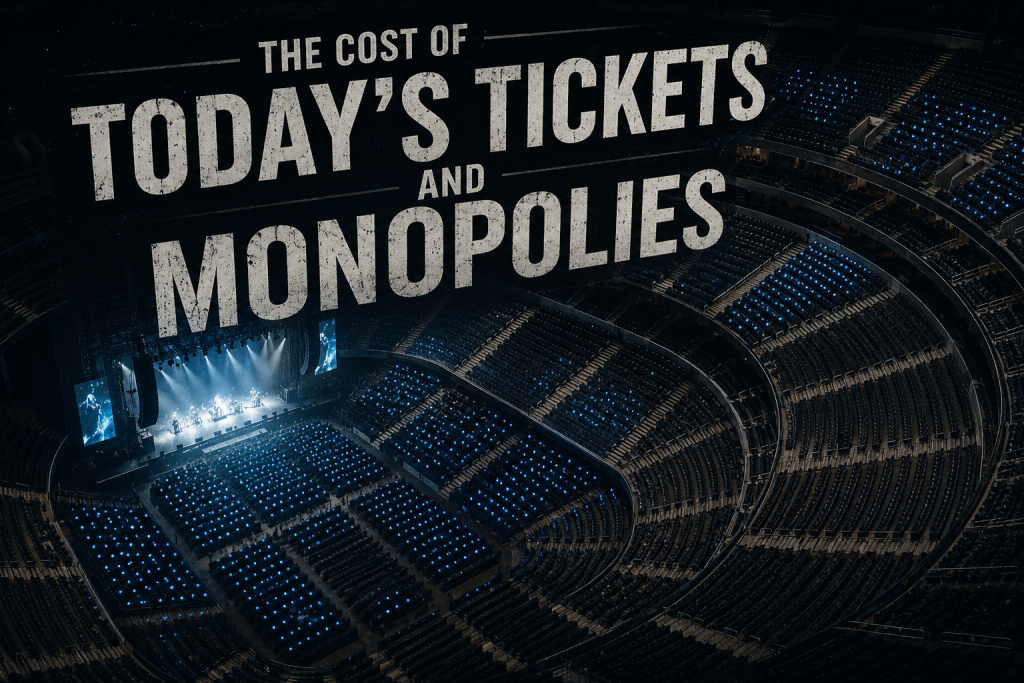
If you have tried buying tickets recently, you have seen it. Entire sections of arenas filled with little blue dots on ticket maps representing unsold seats. Not resale seats. Unsold seats. For years the assumption was: “Fans will always pay.” Turns out there may actually be a breaking point between: “I love this artist” and “I need to keep electricity in my home.”
Some tours are still selling out instantly, especially massive legacy acts and elite performers. But more and more concerts are quietly struggling with:
- partially filled arenas
- weak upper deck sales
- last minute discounting
- and in some cases outright cancellations
And fans have noticed something strange. The “sold out” narrative sometimes does not match the visible reality inside the venue. People are seeing:
- curtain blocked sections
- empty upper levels
- unsold premium seats
- sudden ticket price drops days before shows
- entire rows sitting empty while prices remained artificially high for months
The industry spent years training itself to maximize revenue per seat instead of maximizing full buildings and fan goodwill. That strategy works…until people finally stop playing along.
The irony is brutal. Live music became astronomically expensive at the exact moment people became financially exhausted from literally everything else:
- rent
- groceries
- gas
- subscriptions
- insurance
- and apparently breathing in public
Eventually consumers start prioritizing survival over VIP packages. Who could have predicted that?
The danger for the industry is that concerts stop feeling aspirational and start feeling exclusionary. Music historically connected people across income levels. When average fans begin viewing concerts as luxury experiences reserved primarily for wealthier audiences, something important gets lost culturally.
Because live music was never supposed to feel like a private members club with pyrotechnics. And yet…the shows still matter.
Despite all the frustration, all the pricing insanity, all the monopolistic nonsense, human beings still crave collective musical experiences. Thousands of strangers singing the same lyrics at the same moment still feels magical in a world increasingly designed to isolate people behind screens and subscriptions.
That’s why fans keep coming back. Not because the system deserves loyalty.
Because the music still does.