
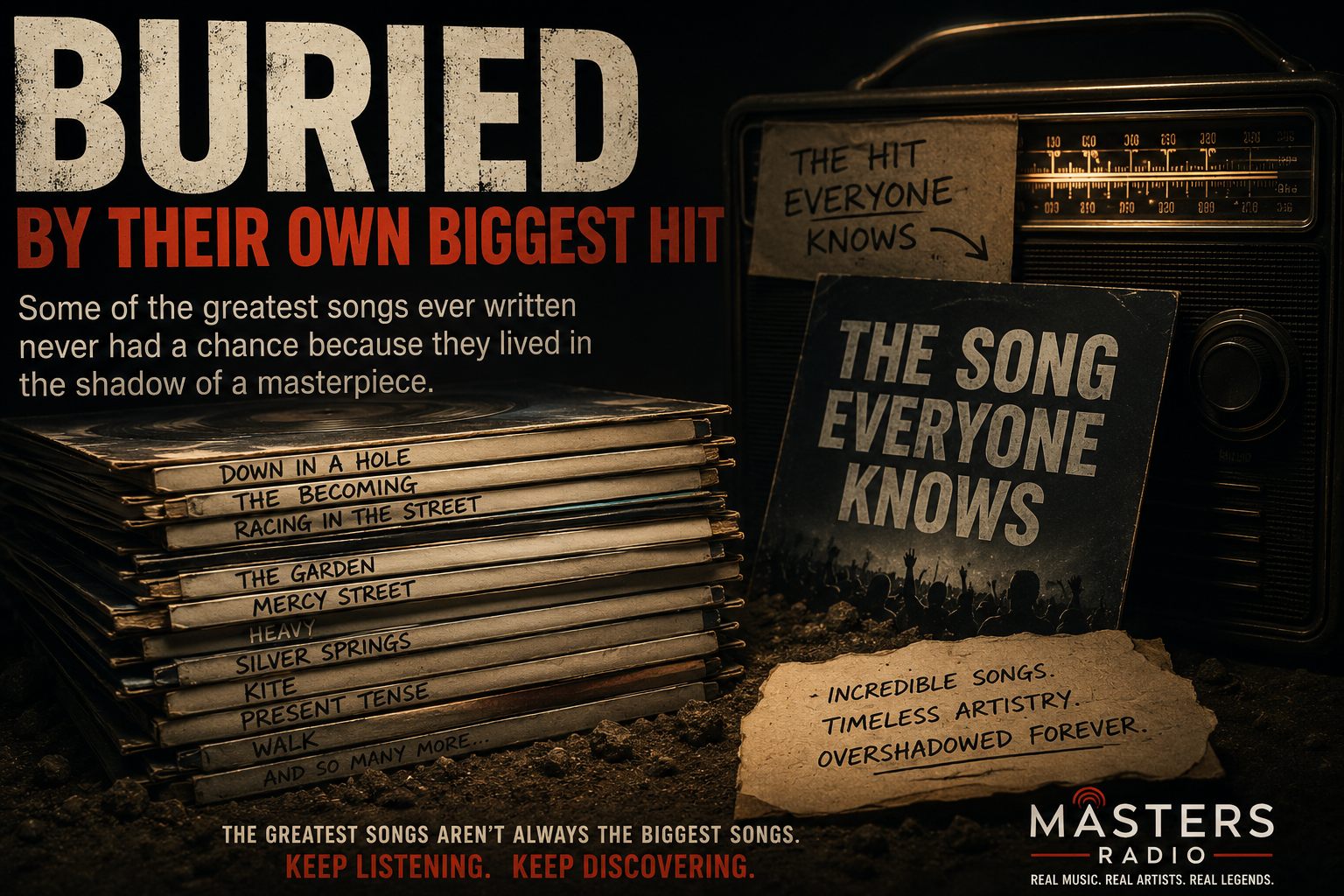
 Some of the greatest songs ever written never had a chance because they lived in the shadow of a masterpiece.
Success can be a strange thing in the music business.
For every artist dreaming of writing one unforgettable hit, there’s an unexpected consequence waiting on the other side. That one song becomes so enormous that it swallows everything around it. Radio stations play it endlessly. Streaming algorithms recommend it relentlessly. Concert audiences demand it every night. Before long, an artist’s catalog becomes defined by a single recording.
The irony is that some of their finest work comes after the hit. Or before it. Or quietly sits on the same album, never receiving the attention it deserved because one song became part of popular culture.
It’s one of the greatest tragedies in modern music. Not because the hit wasn’t great. But because it became so great that listeners stopped digging.
Take Alice In Chains.
“Man in the Box” announced the band to the world and remains one of the defining songs of the grunge era. Its unmistakable guitar riff and Layne Staley’s haunting vocals made it an instant classic. Yet years later, the band released “Down in a Hole.”
If “Man in the Box” was anger, “Down in a Hole” was vulnerability. It showcased a different side of Alice In Chains—one built on melancholy, beautiful harmonies, and emotional honesty. Many fans would argue it’s one of the finest songs Jerry Cantrell and Layne Staley ever created. But it will always live behind the shadow of the song that introduced them to the world.
Then there’s Nine Inch Nails.
Mention Trent Reznor to casual music fans and one title immediately comes to mind. “Closer.”
It became a cultural phenomenon. Yet buried inside The Downward Spiral sits “The Becoming,” a deeply unsettling and emotionally complex piece that explores identity, transformation, and humanity with remarkable depth. It isn’t designed to become a nightclub anthem or a viral clip. It demands patience and repeated listening.
In many ways, it’s a better representation of Reznor as an artist than the song everyone remembers.
Bruce Springsteen may be the greatest example of this phenomenon.
The average listener knows “Born to Run,” “Born in the U.S.A.,” “Glory Days,” and “Dancing in the Dark.” They’re fantastic songs. But ask lifelong Springsteen fans to name their favorites, and the conversation changes.
“Racing in the Street.”
“Incident on 57th Street.”
“Brilliant Disguise.”
“The Rising.”
“Long Walk Home.”
“Moonlight Motel.”
These aren’t forgotten because they lack quality. They’re buried beneath songs that became part of American culture. It’s almost unfair.
The same thing happened to Rush.
“Tom Sawyer” became their signature. “Limelight” followed closely behind. They’re deservedly iconic. But if you stopped listening after those songs, you missed some of the band’s most mature work.
“The Garden.”
“Far Cry.”
“Headlong Flight.”
“Available Light.”
These songs came from musicians who had nothing left to prove. They weren’t chasing radio. They were chasing meaning. The result was some of the richest songwriting of their careers.
This isn’t unique to rock music. It happens everywhere.
Peter Gabriel will forever be associated with “Sledgehammer,” one of the biggest videos in MTV history. Yet songs like “Mercy Street,” “San Jacinto,” and “Secret World” reveal an artist operating on an entirely different emotional level.
Pearl Jam gave the world “Jeremy,” “Alive,” and “Even Flow.”
Wonderful songs. But ask dedicated fans about “Present Tense,” “In Hiding,” “Nothingman,” or “Amongst the Waves,” and you’ll discover a completely different conversation.
The same is true for Collective Soul.
Most people remember “Shine.” Others add “December” or “The World I Know.”
Yet over the last two decades, the band has continued releasing outstanding music. Songs like “Heavy,” “Vent,” “Satellite,” “Good News,” and “Better Now” demonstrate a group that never stopped evolving, even if mainstream radio stopped paying attention.
Why does this happen? Part of the blame belongs to radio.
Traditional radio has always depended on familiarity. Playing proven hits feels safer than introducing audiences to songs they’ve never heard. The same twenty songs become the soundtrack for an artist, while hundreds of others quietly disappear.
Streaming platforms haven’t completely solved the problem. Algorithms often reinforce popularity rather than curiosity. Once a song becomes the “essential” track for an artist, recommendation engines continue feeding listeners that same recording. Instead of encouraging exploration, technology often deepens the shadow cast by the biggest hit.
The result is an illusion. Listeners believe they know an artist because they know the songs everyone else knows. They rarely discover the songs the artists themselves might be most proud of. That’s one of the reasons Masters Radio exists.
We believe music discovery shouldn’t stop after the first hit. Legendary artists continue writing. They continue experimenting. They continue surprising us.
Some of their greatest work arrives decades after the songs that made them famous. The challenge isn’t whether those songs exist. It’s whether anyone is willing to look beyond the obvious.
So the next time you hear “Man in the Box,” spend a little time with “Down in a Hole.” After “Closer,” listen to “The Becoming.” Go deeper into Springsteen’s catalog. Explore Rush after “Tom Sawyer.” You might discover something unexpected.
The greatest songs aren’t always the ones with the most streams. They aren’t always the ones that filled stadiums. Sometimes they’re simply masterpieces that had the unfortunate luck of being released by artists who had already written an even bigger hit.
Those songs deserve another listen. And maybe that’s the greatest joy left in music discovery—not finding a new artist, but rediscovering the one you thought you already knew.