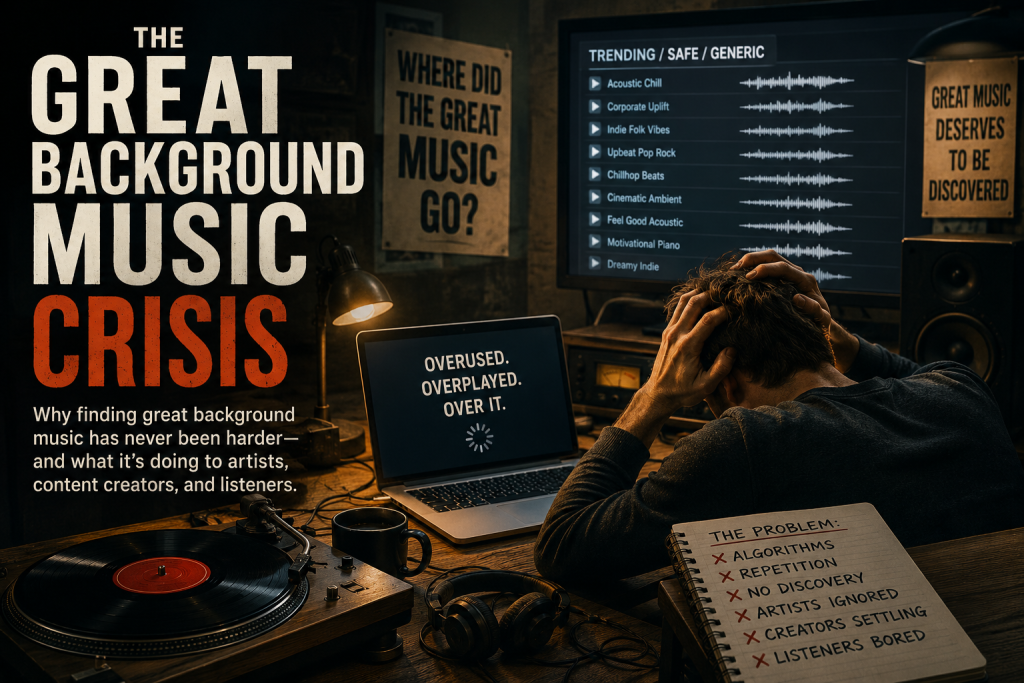
There was a time when music demanded your attention. People bought albums, sat on the floor with headphones, unfolded liner notes, and listened from beginning to end. They debated guitar solos, argued over lyrics, and could remember exactly where they were the first time they heard a favorite song. Music wasn’t something happening in the background. It was the event. Somewhere along the way, we quietly lowered our expectations.
Today, music has become wallpaper. Walk into almost any coffee shop and you’ll hear it. A playlist carefully engineered not to offend anyone, surprise anyone, or distract anyone. Acoustic covers of songs you already know. Mid-tempo indie tracks that blur together after five minutes. The goal isn’t to create a memorable experience. The goal is to make sure nobody notices the music at all.
Retail stores followed the same path years ago. Entire companies exist solely to provide “safe” background music that encourages shoppers to stay a little longer without actually paying attention to what’s playing. Songs have become another part of the store’s interior design, no different than the lighting or paint colors. If customers leave humming a chorus, somebody probably chose the wrong playlist.
Even elevators have become symbols of this shift. “Elevator music” became shorthand for music that exists only to fill silence. It isn’t supposed to inspire. It isn’t supposed to challenge. It’s simply there to prevent awkward quiet. Somewhere along the line, too much of the music industry adopted the same philosophy.
Then social media accelerated everything. Scroll through TikTok, Instagram, or YouTube Shorts and you’ll hear hundreds of songs every day, but rarely for more than fifteen seconds. Music has become an accessory to the content instead of the reason for it. The soundtrack supports the joke, the recipe, the vacation clip, or the dance trend. The song itself becomes disposable because another one arrives before the first one even finishes its chorus.
We’ve trained ourselves to consume music the same way we consume headlines.
- Quickly.
- Passively.
- Forgettably.
The streaming era promised unlimited discovery, yet many listeners feel like they’re hearing the same handful of songs repeated endlessly. Algorithms don’t necessarily recommend what is most meaningful. They recommend what is statistically most likely to keep you listening for another few minutes.
- Safe wins.
- Familiar wins.
- Predictable wins.
That creates a strange irony. Never in history has more music been available, yet it has never been easier for great music to disappear beneath an ocean of acceptable background noise.
Perhaps the biggest victims are established artists. Thousands of musicians who built careers over decades continue releasing remarkable albums every year. Their songwriting has matured. Their musicianship has improved. Their stories have become richer. Yet because they are no longer considered “new,” many streaming platforms and playlists simply move on.
Fans continue hearing the songs they loved in 1987 while never discovering the incredible record released in 2025. That’s not nostalgia. That’s neglect.
Music deserves better than becoming an algorithm’s wallpaper. Artists deserve better than creating songs that exist only to accompany someone making coffee on Instagram. Listeners deserve better than playlists designed to disappear into the room.
Imagine walking into a coffee shop where the owner actually cared about introducing customers to extraordinary music. Imagine retailers known not only for great products but also for helping people discover incredible artists they had forgotten were still creating. Imagine social platforms encouraging listeners to explore complete songs instead of isolated hooks.
Music can still surprise us. It can still stop conversations. It can still make us pull over the car because we need to hear the ending.
Those moments haven’t disappeared because artists stopped creating them. They’ve disappeared because we’ve slowly built systems that reward music for being invisible rather than unforgettable.
At Masters Radio, we believe discovery should feel exciting again. Not because music should constantly scream for attention, but because every great song deserves the chance to become someone’s next favorite. Legendary artists are still writing. They’re still recording. They’re still taking creative risks. The tragedy isn’t that the music no longer exists.
The tragedy is that too many people never hear it. Maybe the greatest background music crisis isn’t really about music at all. Maybe it’s about attention. And perhaps the next great revolution in music won’t come from another algorithm.
It will come from listeners deciding that music deserves to move back to the foreground of our lives.