
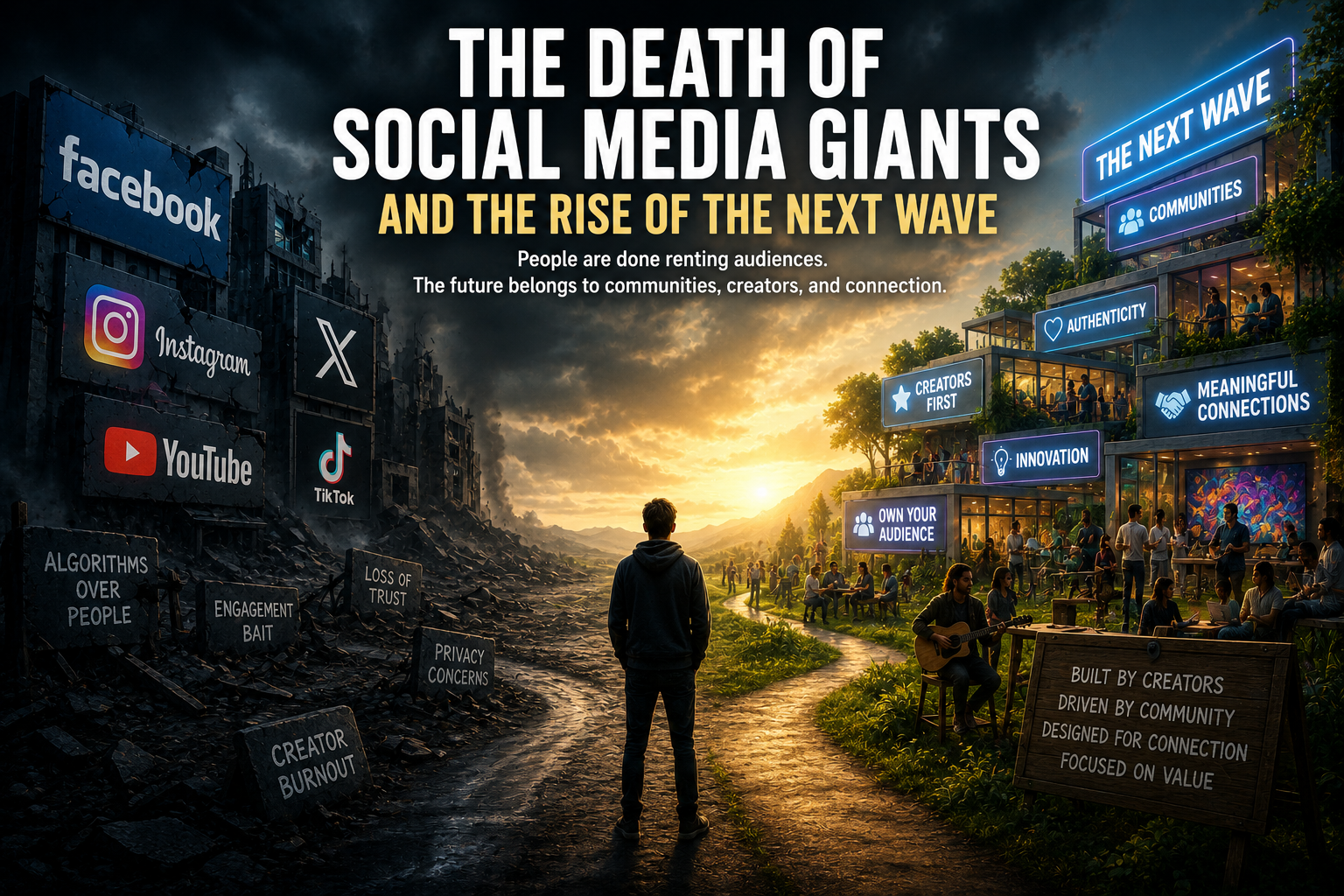
For nearly two decades, the internet has belonged to a handful of companies.
Facebook. Instagram. X. LinkedIn. YouTube. TikTok.
Each arrived with a promise to connect people, democratize publishing, and give everyone a voice. For a while, they delivered exactly that. They helped launch businesses, reunite families, create careers, and even influence governments. Entire industries were born because these platforms lowered the barrier to reaching an audience.
But somewhere along the way, something changed.
The platforms stopped being about people and started becoming about platforms.
Algorithms replaced relationships.
Engagement replaced conversation.
Advertising replaced community.
And creators slowly realized they were no longer building audiences. They were renting them.
That’s a dangerous business model.
Every creator, musician, writer, photographer, podcaster, and entrepreneur has experienced it. One day your content reaches thousands of people. The next day it reaches fifty. Nothing changed except an algorithm that lives inside a company you’ll never speak to and can’t influence.
For years we accepted this because there wasn’t much of an alternative.
Today, there is.
The decline of the large social media companies isn’t necessarily showing up in user numbers. Billions of people still log in every day. The decline is showing up somewhere far more important.
Trust.
Users trust the platforms less.
Creators trust the platforms less.
Businesses trust the platforms less.
Every major platform now feels less like a community and more like a machine constantly demanding more content while giving less in return.
Post more.
Create more videos.
Reply faster.
Follow the latest trend.
Use the newest feature.
Hope the algorithm notices you.
It’s exhausting.
Ironically, the platforms that promised to free creativity have become some of its biggest constraints.
Creators now spend almost as much time trying to understand algorithms as they do creating the work people actually came to see.
Musicians write songs hoping they’ll become fifteen-second trends instead of timeless records.
Writers chase headlines instead of ideas.
Photographers edit for feeds instead of galleries.
Businesses create content because they have to, not because they have something worth saying.
That isn’t innovation.
That’s survival.
The internet has become crowded with people producing content they don’t actually enjoy making because someone convinced them that’s the price of staying relevant.
Here’s the interesting part.
History suggests this is exactly what happens before the next wave arrives.
Every dominant technology platform eventually becomes too large to innovate quickly.
Television networks once controlled entertainment.
Then cable changed everything.
Cable became dominant.
Then streaming disrupted cable.
Yahoo once defined the internet.
Google changed search forever.
MySpace seemed untouchable.
Then Facebook appeared.
No platform lasts forever.
The companies usually don’t disappear overnight. They become something worse.
Predictable.
Safe.
Bureaucratic.
Focused on protecting what they already own instead of inventing what comes next.
That creates opportunity.
The next generation of platforms won’t win simply because they have better technology.
They’ll win because they’ll solve problems the giants no longer recognize.
People don’t necessarily want another place to scroll endlessly.
They want communities.
They want expertise.
They want authenticity.
They want platforms designed around shared interests instead of generalized attention.
We’re already seeing the early signs.
Small communities continue growing.
Newsletter platforms have exploded.
Private memberships are thriving.
Independent creator platforms are attracting loyal audiences.
Niche communities routinely outperform giant public feeds because everyone actually shares a common interest.
That may sound like a step backward.
In reality, it’s a step forward.
The early internet wasn’t built around billions of strangers.
It was built around people finding others who cared about the same things they did.
Music.
Photography.
Gaming.
Technology.
Cars.
Travel.
Books.
Communities were smaller, but they were deeper.
Today, many people have thousands of followers and very few genuine connections.
The next generation of platforms has an opportunity to reverse that trend.
Success won’t belong to the company with the biggest user base.
It will belong to the company with the strongest communities.
That distinction matters.
A million people loosely connected by an algorithm are often less valuable than fifty thousand people united by genuine passion.
That’s particularly true in music.
Music has become another casualty of the endless feed.
Songs compete against recipes.
Interviews compete against cat videos.
Albums compete against political arguments.
Great art survives only until someone swipes.
Imagine instead a platform built specifically for music discovery.
Imagine readers visiting because they genuinely care about music rather than because an algorithm happened to place a post in front of them.
Imagine artists reaching audiences already interested in hearing new music instead of fighting for attention against unrelated entertainment.
That’s not nostalgia.
That’s specialization.
And specialization is becoming one of the biggest opportunities on the internet.
People are growing tired of giant platforms trying to be everything to everyone.
The future belongs to platforms willing to become indispensable to someone.
That’s a very different philosophy.
The giants optimized for scale.
The next generation will optimize for value.
The giants measured time spent scrolling.
The next generation will measure meaningful engagement.
The giants rewarded outrage because outrage generates clicks.
The next generation will reward expertise because expertise builds loyalty.
Perhaps that’s why we’re entering one of the most exciting periods in digital history.
For the first time in years, entrepreneurs no longer need to build “the next Facebook.”
They simply need to build the best destination for a specific community.
That’s a much more achievable challenge.
It’s also a much healthier one.
Because communities built around passion tend to outlast communities built around algorithms.
Will Facebook disappear tomorrow?
Of course not.
Will YouTube vanish?
Highly unlikely.
The giants aren’t dying because people are abandoning them overnight.
They’re slowly losing the one thing that made them extraordinary.
The feeling that they represented the future.
History has a funny way of repeating itself.
Every generation believes the dominant companies are permanent.
Then someone quietly starts building something better.
Not bigger.
Better.
And one day everyone wonders why they didn’t see it coming.
The next wave of great internet companies is almost certainly being built right now.
The founders probably aren’t trying to replace the giants.
They’re simply solving problems the giants forgot existed.
That’s how every revolution begins.
Not with the fall of an empire.
But with the rise of a better idea.